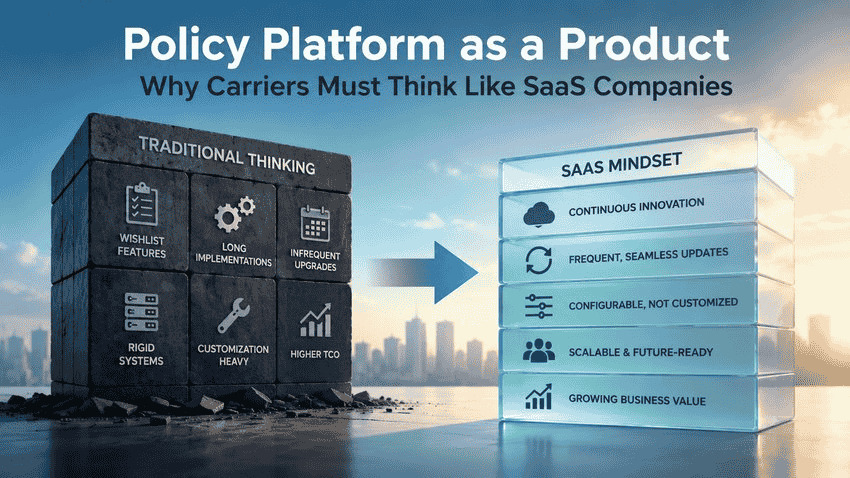
Insurance technology is entering a new phase. Moving applications to the cloud was once viewed primarily as an IT modernization project. Today, SaaS in the insurance industry is increasingly becoming part of a broader strategy involving artificial intelligence, data integration, automation, cybersecurity, and faster product development.
For American insurers, this shift matters because technology is increasingly connected to core business outcomes. A modern platform can influence how quickly an insurer evaluates risk, processes claims, communicates with policyholders, and responds to changing market conditions.
The National Association of Insurance Commissioners (NAIC) says technology-driven innovation is affecting nearly every part of insurance, from product design and risk assessment to sales and claims. It also highlights the growing importance of big data, connected devices, AI, and automation.
SaaS Is Becoming More Than a Software Delivery Model
Traditional SaaS is straightforward: a vendor hosts an application and customers access it through the internet.
Insurance is making the model more strategic.
A modern insurance SaaS platform can act as a connection point between employees, customer data, external data sources, automated workflows, analytics, and AI services. Instead of treating each application as an isolated system, insurers can use cloud-based platforms as components of a broader digital architecture.
This approach can be particularly valuable for insurers dealing with complex legacy environments.
The objective is not necessarily to replace every existing system immediately. Instead, insurers can modernize specific capabilities while gradually improving integration between old and new technologies.
The Real Value May Be Faster Decision-Making
One of the most important benefits of SaaS is not simply infrastructure savings. It is the potential to reduce the time required to move information through an organization.
Consider underwriting.
An underwriter may need information from an application, policy history, inspection data, third-party sources, internal databases, and other documents before making a decision. If these sources are fragmented, employees can spend significant time collecting and reconciling information.
A well-integrated SaaS environment can bring relevant information into a more unified workflow.
When analytics and AI are added, the system can also help identify patterns and prioritize information for human review.
Deloitte's insurance technology research identifies cloud migration, data transformation, AI infrastructure, and cybersecurity as strategic priorities as insurers increase their use of AI.
The result is potentially a faster decision cycle without removing the professional judgment that remains important in insurance.
SaaS and AI Are Moving Closer Together
The next generation of insurance SaaS is likely to be increasingly AI-enabled.
Deloitte highlights specialized small language models as one emerging insurance technology trend. These models can be designed for specific tasks and may be better suited than general-purpose models for certain insurance workflows.
This creates several potential applications.
For example, an insurance platform could help summarize claim documents, classify incoming information, assist customer-service representatives, identify missing underwriting data, or provide an underwriter with relevant information from large document sets.
However, AI adoption also introduces new responsibilities.
The NAIC reports that 88% of surveyed private passenger auto insurers and 70% of surveyed homeowners insurers said they currently use, plan to use, or plan to explore AI/ML models. The corresponding figures were 58% for surveyed life insurers and 92% for surveyed health insurers.
These figures demonstrate that AI is moving beyond experimentation across multiple insurance lines.
A Key Insight: Data Quality Can Determine SaaS Value
Buying a sophisticated SaaS platform does not automatically produce better insurance outcomes.
The quality, accessibility, and governance of the underlying data matter just as much.
If policy information is inconsistent across systems, claims records are incomplete, or external datasets cannot be properly validated, automation may simply make existing problems happen faster.
That is why insurers should evaluate SaaS investments together with their data strategy.
Questions should include:
- Is critical data accessible through reliable interfaces?
- Can information be traced back to its source?
- Are duplicate or conflicting records identified?
- Can data be governed consistently?
- Can AI systems use the information appropriately?
- Can important decisions be audited?
This is where technology modernization becomes an enterprise transformation rather than an IT purchasing exercise.
Claims Could Become More Proactive
Another emerging opportunity is moving claims technology from reactive processing toward proactive risk management.
Traditional claims systems primarily become important after a loss occurs. Connected data, analytics, and SaaS-based workflows can potentially allow insurers to identify information earlier and coordinate responses more efficiently.
NAIC notes that insurtech is helping insurers automate traditional processes, speed claims, prevent losses, and create more personalized pricing and services.
For example, digital tools can help insurers organize incoming information and prioritize cases requiring immediate attention.
Over time, the combination of connected data and intelligent SaaS applications could make insurance more focused on preventing or mitigating losses rather than simply paying for them afterward.
Cybersecurity Cannot Be an Afterthought
Greater SaaS adoption also increases the importance of cybersecurity and vendor governance.
Insurance organizations handle highly sensitive information, so cloud adoption must be accompanied by strong controls covering access, encryption, monitoring, incident response, business continuity, and third-party risk.
This becomes even more important when SaaS applications incorporate AI or external data.
The NAIC's AI Model Bulletin emphasizes responsible governance and reminds insurers that decisions made or supported by AI must comply with applicable insurance laws and regulations. It also addresses concerns including inaccurate results, unfair bias, and data vulnerabilities.
In other words, convenience cannot replace accountability.
Human Expertise Still Matters
A common misconception about intelligent SaaS is that automation will eliminate the need for insurance professionals.
The more realistic model is collaboration.
Deloitte describes a human-in-the-loop approach in which employees work alongside AI-enabled systems. This model can allow technology to handle repetitive activities while professionals concentrate on judgment, exceptions, relationships, and complex decisions.
For insurers, this distinction is important.
The objective should be to make experienced underwriters, adjusters, agents, and customer-service professionals more effective—not simply to automate everything possible.
What Insurance Leaders Should Do Next
Before adopting a new SaaS platform, insurance executives should evaluate the technology against long-term business objectives.
A strong assessment should examine:
- Integration: Can the platform communicate with existing systems?
- Data: Can the insurer maintain reliable and governed information?
- AI readiness: Can the platform support responsible AI use?
- Security: Does it meet the organization's cybersecurity and vendor-risk standards?
- Scalability: Can it support future growth and new products?
- Governance: Can important decisions and automated processes be monitored?
- Business value: Will it improve measurable outcomes rather than simply add another application?
This approach helps prevent SaaS from becoming another disconnected technology purchase.
The Future of SaaS in Insurance
The future of SaaS in the insurance industry will likely be defined by integration rather than isolated applications.
Cloud platforms, AI, analytics, external data, automation, cybersecurity, and human expertise are increasingly becoming interconnected parts of the insurance operating model.
For American insurers, the competitive advantage may come from how effectively these components work together.
SaaS can provide the foundation, but technology alone does not create transformation. Insurers also need strong data governance, responsible AI practices, cybersecurity, regulatory awareness, and employees who know how to use new tools effectively.
The winners in this next phase may not be the insurers with the largest technology budgets. They may be the organizations that can turn technology into faster decisions, better risk insight, stronger customer experiences, and more adaptable insurance operations.