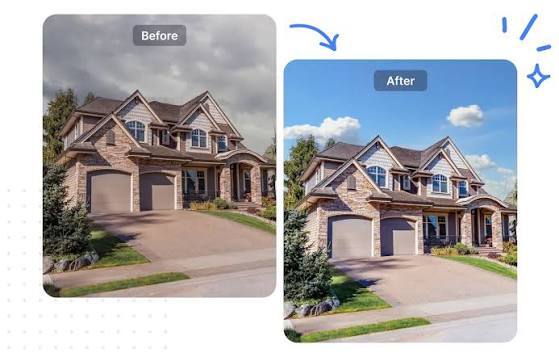
High-quality property photography plays an important role in real estate marketing. Buyers often see property images before reading a full listing description, so clear, attractive, and accurate photographs can help create a strong first impression. For this reason, many professionals are exploring an AI property photo editor to improve images efficiently while maintaining a professional appearance.
A best AI real estate photo editor can assist with tasks such as lighting correction, color enhancement, image cleanup, sky replacement, and other editing processes. However, the right tool depends on the photographer's workflow, the type of property, and the desired level of editing.
What Is an AI Property Photo Editor?
An AI property photo editor is software that uses artificial intelligence to analyze and modify real estate photographs. Instead of requiring every adjustment to be performed manually, AI-powered software can identify elements within an image and apply automated improvements.
For example, an editor may recognize a dark interior and adjust exposure or identify a dull sky and provide an editing option for improving the outdoor appearance.
The purpose is to reduce repetitive work while giving photographers and agents more time to focus on other parts of their business.
Why Real Estate Professionals Use AI Editing
Real estate photography often involves editing many images for different listings. Manually correcting every photograph can take considerable time.
An AI property photo editor can automate certain repetitive tasks, making the editing workflow more efficient.
Depending on the software, users may be able to improve brightness, contrast, white balance, sharpness, and color consistency with relatively few adjustments.
This can be particularly helpful for agents or photographers who need to prepare multiple property listings within a limited timeframe.
Improving Interior Photos
Interior photography can be challenging because rooms may contain different lighting conditions. Natural light from windows can mix with artificial lighting, creating inconsistent colors.
An AI property photo editor can analyze these images and help balance exposure, brightness, and color.
The goal should be to present the property clearly rather than make it appear significantly different from reality.
Accurate representation remains important when editing real estate photographs.
Enhancing Exterior Images
Exterior photographs are often used as the main image for property listings. Weather and lighting conditions can strongly influence their appearance.
An AI property photo editor may offer tools for improving brightness, contrast, sky appearance, and overall color.
For example, an overcast photograph may be adjusted to improve visibility and visual balance. However, edits should remain realistic and should not misrepresent the actual property or surroundings.
Virtual Staging
Some AI editing platforms provide virtual staging features. These tools can add digital furniture to empty rooms to help potential buyers imagine how the space might be used.
An AI property photo editor with virtual staging capabilities can be useful for vacant properties.
However, digitally added furniture should be clearly represented as virtual when required by applicable advertising rules or platform policies. Buyers should be able to distinguish between the actual property and digitally created elements.
Removing Unwanted Objects
Real estate photographs sometimes contain small distractions such as temporary furniture, cables, bins, or other objects.
Some AI-powered editors offer object-removal features that can help clean up photographs.
The best AI real estate photo editor for a particular user may depend on how accurately the software handles these edits and how much control it provides.
Removing temporary distractions can improve composition, but permanent features of the property should not be removed in a way that could mislead viewers.
Consistency Across a Property Listing
A professional listing usually contains multiple photographs. If every image has different brightness, color temperature, or contrast, the gallery may look inconsistent.
An AI property photo editor can help create a more consistent visual style across a set of images.
Consistency can make a listing easier to browse and can give the presentation a more organized appearance.
Saving Time During Editing
One of the main advantages of AI editing is workflow efficiency. Instead of adjusting every photograph manually, a photographer can use automated tools for repetitive corrections and then review the results.
This approach can be particularly useful for professionals handling multiple properties each week.
The time saved can be redirected toward photography, client communication, marketing, or other business activities.
Choosing an AI Property Photo Editor
When evaluating an AI property photo editor, consider the features that match your actual workflow.
Important factors may include:
Not every platform offers the same capabilities, so comparing features before subscribing can help users select an appropriate solution.
Accuracy and Realistic Editing
AI editing should improve photographs without creating a misleading representation of the property.
For real estate marketing, accuracy is particularly important. Changing permanent structures, room dimensions, views, or major property features can create unrealistic expectations.
The best AI real estate photo editor should therefore be used as a professional editing aid rather than a tool for creating an inaccurate version of a property.
AI Editing and Professional Photographers
AI does not necessarily replace professional photography. Instead, it can complement the photographer's existing workflow.
A photographer can capture the property carefully and then use an AI property photo editor for routine corrections.
Human review remains valuable because automated systems can occasionally produce unexpected results, particularly with complex lighting, reflective surfaces, windows, mirrors, or detailed backgrounds.
Final Thoughts
An AI property photo editor can simplify many aspects of real estate image preparation. From correcting lighting and improving colors to removing temporary distractions and supporting virtual staging, AI tools can reduce repetitive editing work.
When selecting the best AI real estate photo editor, users should consider the software's features, accuracy, workflow, pricing, and ability to produce realistic results.
The most effective approach combines automated editing with human review. AI can handle routine adjustments quickly, while photographers and real estate professionals can ensure that the final images remain accurate, attractive, and representative of the actual property.
See more blogs: Visit Here