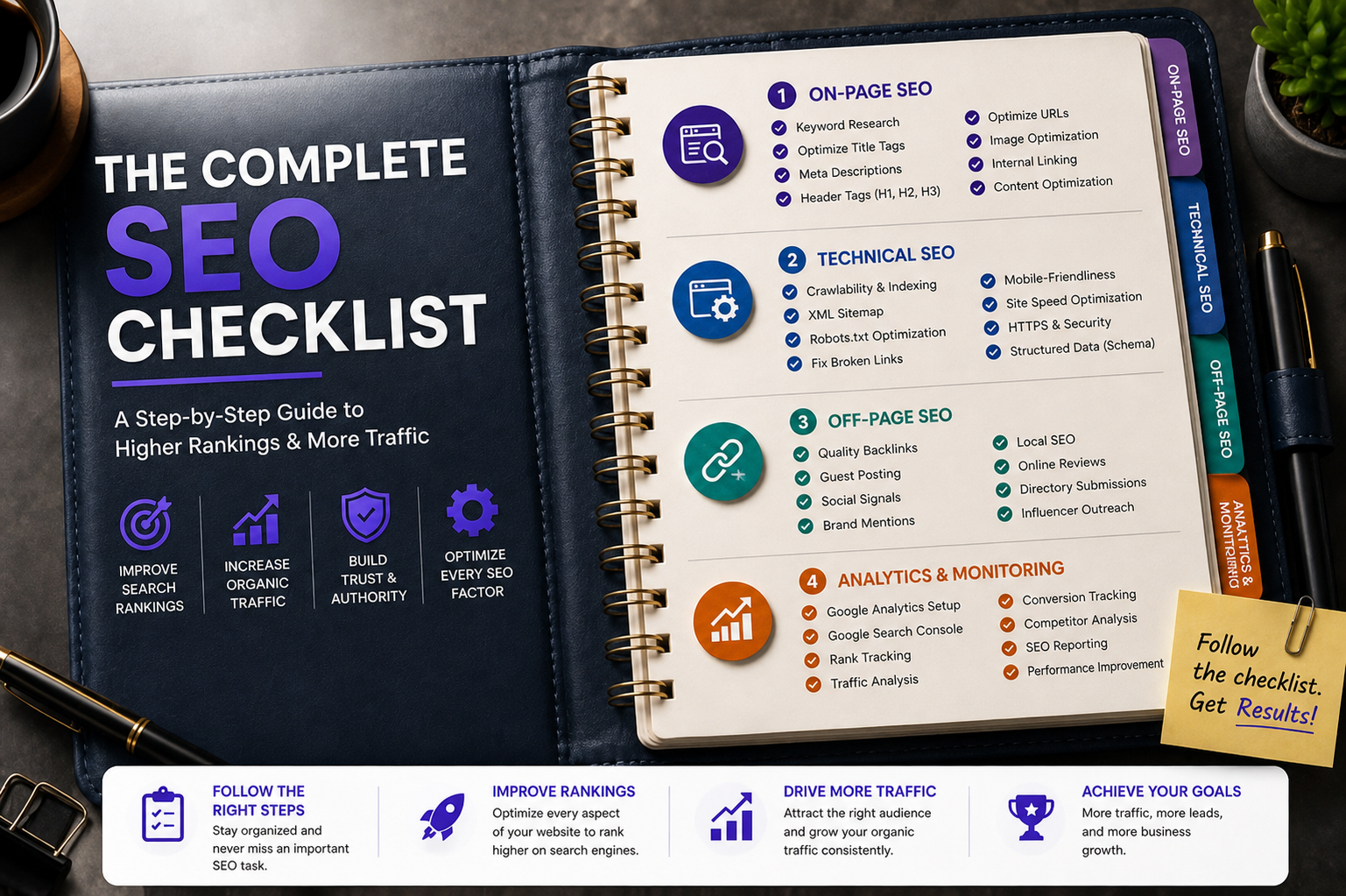
Search engine optimization can seem complicated when you are just starting. There are keywords to research, pages to optimize, technical issues to fix, content to create, and backlinks to earn. However, SEO becomes much easier to manage when you follow a structured process. A complete SEO checklist helps beginners understand the essential areas that need attention and provides a clear foundation for improving organic visibility over time.
For businesses, bloggers, ecommerce stores, and service providers in Pakistan, working with an SEO agency in Karachi or managing SEO independently begins with understanding the basics. A successful SEO strategy is not based on one trick or a single ranking factor. It involves making your website accessible to search engines, creating useful content, targeting relevant keywords, improving user experience, and building credibility.
The purpose of a complete SEO checklist is to organize these important activities into a practical SEO framework. Instead of randomly changing titles or publishing articles without a clear strategy, beginners can understand how different SEO elements work together. A technically healthy website, useful content, strong internal links, and genuine authority can all contribute to better long-term search performance.
Whether your goal is to attract more customers in Karachi, Lahore, Islamabad, Rawalpindi, Faisalabad, Multan, or across Pakistan, SEO can help you reach people who are actively searching for relevant products, services, and information. The key is to build a strong foundation and improve your website consistently.
Understand the Basics of SEO Before You Start
Before making major changes to your website, it is important to understand what SEO is designed to achieve. Search engines aim to provide useful results that match the needs of users. Your SEO strategy should therefore focus on making your website relevant, accessible, useful, and trustworthy.
Understand Search Intent
Every search has an intention behind it. Some people search because they want to learn about a topic, while others want to compare products, find a local business, or make a purchase.
For example, someone searching for information about keyword research may want a detailed guide. Someone searching for an SEO service in Pakistan may be looking for an agency. A person searching for a specific product may want a product page rather than a long educational article.
Understanding search intent should be one of the first parts of a complete SEO checklist because it helps you create the right type of content for the right audience. Before targeting a keyword, consider what the searcher actually expects to find.
Understand How Search Engines Process Websites
Search engines generally discover pages through crawling, process information through indexing, and evaluate pages for ranking based on relevance and other signals.
A website must first be accessible before its content can compete in search results. If an important page cannot be crawled or indexed, even excellent content may struggle to appear.
This is why SEO includes both visible content improvements and technical website maintenance.
Set Up Essential SEO Tools
SEO decisions should be based on data whenever possible. Several tools can help beginners understand how their website performs in search and identify areas that need improvement.
Monitor Search Performance
Website owners should monitor how often their pages appear in search results, which queries generate visibility, and how users interact with their listings.
Search performance data can reveal pages that receive many impressions but relatively few clicks. It can also identify keywords for which your content already has visibility but may need further optimization.
Monitoring performance regularly helps you make informed decisions instead of relying only on assumptions.
Track Website Traffic and User Behavior
Website traffic data can show where visitors come from and which pages receive the most attention. Organic search traffic is particularly useful for measuring SEO growth.
However, traffic alone is not always the most important metric. An ecommerce website may focus on sales and revenue, while a service business may care more about inquiries and leads.
A complete SEO checklist should therefore connect SEO performance with actual business goals. The objective is not simply to increase visitor numbers but to attract relevant users who are likely to take meaningful action.
Perform Proper Keyword Research
Keyword research helps you understand how people search for information, products, and services. It provides the foundation for content planning and helps prevent businesses from targeting topics based only on assumptions.
Find Keywords Relevant to Your Audience
Start by identifying the products, services, topics, and questions that are most relevant to your business. Then research the language your potential customers use when searching online.
For businesses in Pakistan, local terms can also be important. Users may include city names, country names, or phrases related to buying online, prices, delivery, and nearby services.
The best keywords are not always the ones with the highest search volume. A highly specific search can attract fewer visitors but deliver a more qualified audience.
Use Long Tail Keywords
Long-tail keywords are more specific phrases that often reveal clearer search intent. They can be especially useful for new websites and businesses competing against larger brands.
For example, a general keyword may be highly competitive, while a more detailed phrase related to a specific service, product feature, or location may provide a more realistic opportunity.
Using long-tail keywords allows you to create focused pages that answer specific user needs. This makes keyword research an important part of a complete SEO checklist for beginners who want to build organic visibility gradually.
Research Related Topics and Questions
Do not focus only on one exact phrase. Research related questions and supporting topics that your audience may also want to understand.
A page targeting an SEO topic may naturally discuss keywords, content, backlinks, technical performance, search intent, and analytics. Covering relevant concepts can create more useful and complete content.
This approach helps avoid keyword stuffing and supports a more natural writing style.
Create a Clear Website Structure
A website should be organized in a way that makes sense to visitors and search engines. Poor structure can make important pages difficult to discover and create confusion about the relationship between different sections.
Organize Pages by Topic
Related pages should be grouped together logically. An ecommerce store can organize products into categories and subcategories, while a service business can separate different services into clear sections.
Blog content should also connect with relevant categories and supporting articles. A clear structure helps visitors explore your website without unnecessary difficulty.
Website organization is an important part of a complete SEO checklist because it affects both user experience and search engine accessibility.
Keep Important Pages Easy to Find
Your most valuable pages should not be hidden deep within the website. Important service pages, product categories, and key resources should be accessible through logical navigation and internal links.
A clear website hierarchy can also help search engines discover and understand important content.
Review your navigation regularly, particularly when adding new pages or products. As websites grow, a structure that once worked well can become more complicated.
Optimize Important On-Page SEO Elements
On-page SEO involves improving the elements directly available on your website. These optimizations help search engines understand page topics and help users quickly identify whether the content is relevant to their needs.
Write Clear Page Titles
Every important page should have a clear and descriptive title. The title should communicate the topic while making the page appealing to relevant users.
Include important keywords naturally when appropriate, but avoid creating titles that sound repetitive or unnatural.
A product page should clearly identify the product, while a service page should explain the service being offered. Blog titles should accurately reflect the information readers can expect.
Use Logical Heading Structure
Headings organize content into meaningful sections. The H1 should represent the primary topic, while H2 and H3 headings can introduce supporting sections and detailed explanations.
A clear heading structure improves readability, especially for longer content. It can also help search engines better understand the relationship between different sections.
Avoid using headings only for design purposes. Each heading should describe the content that follows it.
Create Useful Meta Descriptions
A meta description can help users understand what a page is about when it appears in search results. Write a concise description that accurately represents the content and highlights its value.
For commercial pages, explain the product or service clearly. For educational content, describe the main topic and benefit.
Although a meta description is not simply a shortcut to higher rankings, it can support a clearer search presence and encourage relevant users to visit the page.
Create High Quality SEO Content
Content is one of the strongest foundations of a successful SEO strategy. Search engines need useful pages to evaluate, while visitors need information that solves problems or helps them make decisions.
Write for Real Users
Avoid creating content only to repeat keywords. A useful article should answer questions, explain concepts clearly, and provide information that the intended audience can understand.
For businesses in Pakistan, content can be more useful when it addresses relevant local needs. Ecommerce websites can explain delivery and payment options, while service businesses can clarify service areas and customer expectations.
Writing for real users should remain a central principle of any complete SEO checklist.
Cover Topics Thoroughly
A useful page should address the important aspects of its topic without becoming repetitive. Before writing, research the questions users may have and the information competing pages provide.
Then look for opportunities to make your content more useful. You may provide clearer explanations, more practical context, better organization, or additional relevant information.
The goal is not always to create the longest article. The goal is to provide the right level of information for the searcher's needs.
Update Existing Content
SEO content should not be forgotten after publication. Review important pages periodically to identify outdated information, missing details, or new search opportunities.
Updating existing content can often be more efficient than creating large amounts of new content. Improve pages that already receive impressions or have the potential to perform better.
Regular updates help maintain accuracy and relevance over time.
Improve Technical SEO Foundations
Technical SEO focuses on the underlying parts of your website that affect crawling, indexing, performance, and usability.
Make Sure Important Pages Can Be Crawled
Search engines need to access your important pages before they can process them. Check that valuable content is not accidentally blocked by incorrect technical settings.
Internal links and a logical website structure can also support page discovery. Pages with no meaningful connections to the rest of the website may be more difficult to find.
Technical checks should be included in every complete SEO checklist because content cannot perform effectively if search engines cannot access it properly.
Check Indexing Status
Crawling and indexing are not the same. A page may be discovered without being added to search results.
Review whether your important pages are indexed and investigate unexpected exclusions. Problems may be caused by duplication, technical directives, accessibility issues, or low-value content.
Understanding why a page is not indexed can help you avoid making unnecessary changes to content when the actual problem is technical.
Improve Website Speed
Slow pages can create a poor experience and make visitors leave before interacting with your website.
Large image files, unnecessary scripts, excessive plugins, poor hosting, and unoptimized website elements can all affect performance.
Review page speed regularly, especially after installing new applications or making significant design changes. A fast website supports both usability and overall SEO quality.
Optimize for Mobile Users
Many users in Pakistan access websites through smartphones. Your website should be responsive and easy to use across different screen sizes.
Check that text is readable, buttons are easy to select, menus work correctly, and important actions can be completed without difficulty.
Ecommerce websites should pay particular attention to mobile product pages and checkout processes because a poor mobile experience can directly affect sales.
Build a Strong Internal Linking Strategy
Internal links connect pages within your website. They help visitors discover useful information and provide search engines with additional context about your website structure.
Link Related Content Naturally
When writing a blog post, link to relevant articles, products, categories, or services where the connection provides genuine value.
For example, an article about SEO basics may link to guides about keyword research, technical SEO, or content optimization.
Internal links should fit naturally into the content. Avoid adding links simply because you want to repeat a keyword.
Support Important Commercial Pages
Blog content can help guide users toward relevant commercial pages. A useful informational article may naturally connect readers with a service or product related to the topic.
This can help create a stronger website structure and make valuable pages easier to discover.
A well-planned internal linking strategy is a valuable part of a complete SEO checklist because it supports both user navigation and content discovery.
Earn Quality Backlinks and Build Authority
Backlinks are links from external websites to your pages. Relevant and trustworthy backlinks can help build authority and expose your website to new audiences.
Focus on Quality Over Quantity
Not every backlink provides the same value. A relevant mention from a trusted website is generally more useful than a large number of unrelated links.
Avoid strategies that focus only on generating as many backlinks as possible. Low-quality link building can create a poor-quality backlink profile and may not provide long-term value.
Instead, focus on creating useful content and building genuine relationships within your industry.
Create Content Worth Referencing
People are more likely to link to resources that provide real value. Comprehensive guides, original research, expert insights, practical resources, and useful data can all create opportunities for natural mentions.
A business does not need to publish complex research to create link-worthy content. Even a well-written local guide or a genuinely useful industry resource can provide value to relevant audiences.
Authority building takes time, but consistent quality can create sustainable results.
Optimize for Local SEO in Pakistan
Local SEO is important for businesses that serve customers in specific cities or regions. People frequently search for nearby services, local providers, and businesses that operate in their area.
Create Genuine Location Relevance
If your business serves Karachi, Lahore, Islamabad, Rawalpindi, Faisalabad, or another location, provide accurate information about the areas you actually serve.
Location pages should offer genuine value. Avoid creating nearly identical pages that only change the city name.
A useful local page can explain available services, local customer needs, service areas, and relevant business information.
Build Trust Through Accurate Information
Your business information should be consistent across your website and relevant online profiles. Customers should be able to find accurate contact details and understand what your business offers.
Reviews and customer feedback can also influence how potential customers evaluate a business. Focus on providing a positive customer experience and encourage genuine feedback.
For businesses competing in major cities, local optimization can be an important part of a complete SEO checklist.
Improve User Experience and Website Trust
SEO is closely connected with how users experience your website. A visitor should be able to understand your business, navigate important pages, and take action without unnecessary confusion.
Make Navigation Simple
A clear menu and logical navigation structure make websites easier to use. Visitors should not need to search through multiple unrelated pages to find important information.
Keep the website organized as it grows. Add new categories and sections thoughtfully to avoid creating a confusing structure.
Simple navigation can also help search engines understand how different pages connect.
Add Clear Trust Information
Businesses should provide accurate information about who they are and how customers can contact them. Ecommerce stores should clearly explain important policies related to shipping, payments, returns, exchanges, and customer support.
Service businesses should clearly describe their expertise and available services.
Trust is especially important when users are considering making an online purchase or submitting personal information. A professional and transparent website can improve confidence.
Understand Competitor SEO Strategies
Competitor research can help beginners identify opportunities and understand the level of competition in search results.
Analyze Competing Search Results
Search for your important keywords and review the pages that already rank. Look at the type of content, depth of information, page structure, and search intent they target.
Do not copy competitors. Instead, use your research to understand what users expect and identify areas where you can provide additional value.
Competitor analysis can help you discover content gaps and improve your own strategy.
Find Opportunities for Improvement
A competitor may rank well because it has better content, stronger authority, clearer website structure, or greater topical coverage.
Identify where your website is weaker and prioritize improvements based on importance.
For businesses searching for the best SEO agency in Karachi, a professional SEO strategy should involve analyzing competition while building a unique approach based on the business, target audience, and goals.
Measure SEO Results and Track Progress
SEO requires regular monitoring because rankings, search behavior, and competition can change over time.
Track Organic Visibility
Monitor impressions, clicks, traffic, and the performance of important pages. Look for trends instead of focusing only on daily changes.
Some pages may gradually gain visibility as search engines process improvements and users discover the content.
Tracking progress helps identify which strategies are producing useful results.
Measure Business Outcomes
Organic traffic is valuable, but the ultimate goal should connect with your business objectives.
An ecommerce store may measure purchases, revenue, and product page performance. A service business may focus on inquiries, leads, and phone calls.
Understanding which pages generate valuable actions can help you prioritize future SEO work.
A complete SEO checklist should therefore include both search performance and business results.
Avoid Common SEO Mistakes
Beginners often make mistakes by following outdated advice or focusing too heavily on shortcuts.
Avoid Keyword Stuffing
Repeating the same keyword excessively does not automatically improve relevance. It can make content difficult to read and reduce the overall quality of the page.
Use primary keywords naturally and include related terms where they genuinely fit.
Focus on explaining the topic clearly rather than attempting to force the keyword into every sentence.
Avoid Publishing Thin Content
A large number of low-value pages is not necessarily better than a smaller collection of useful resources.
Before publishing, ask whether the page has a clear purpose and provides information that users would find valuable.
Improve or consolidate pages that offer little unique value.
Avoid Ignoring Technical Problems
Content and backlinks cannot fully compensate for serious technical problems. If important pages are slow, inaccessible, or not indexed correctly, other SEO efforts may be limited.
Regular technical maintenance should remain part of your long-term SEO process.
Create a Long-Term SEO Strategy
SEO is most effective when treated as an ongoing process. Search behavior changes, competitors improve their websites, and businesses continue to add products, services, and content.
Prioritize the Most Important Tasks
Beginners do not need to optimize everything at once. Start with the pages and issues that have the greatest potential impact.
For example, fix serious crawling or indexing problems before spending time on minor improvements. Improve important commercial pages and content that already has strong potential.
A structured complete SEO checklist can help you identify priorities and avoid becoming overwhelmed by every possible optimization task.
Review and Improve Regularly
SEO performance should be reviewed consistently. Update outdated content, fix broken links, improve weak pages, and monitor important technical issues.
Look for new keyword opportunities and changes in search behavior.
Consistent improvement is usually more effective than making a large number of random changes and then ignoring the website for months.
Conclusion
A complete SEO checklist gives beginners a practical framework for building stronger organic visibility. SEO involves more than choosing keywords or collecting backlinks. A successful strategy combines keyword research, useful content, on-page optimization, technical SEO, internal linking, website performance, local relevance, authority building, and regular measurement.
For businesses and website owners in Pakistan, the process should begin with understanding your audience and creating a website that provides genuine value. Make sure search engines can access important pages, organize your website clearly, optimize content around relevant search intent, and create a smooth experience for visitors.
The most effective complete SEO checklist is one that supports long-term improvement rather than temporary shortcuts. SEO results may take time, especially in competitive industries, but consistent work can strengthen your website's relevance, authority, and visibility.
Continue reviewing your website, measuring results, and improving the areas that matter most to your audience and business goals. With a strong foundation and a clear strategy, beginners can develop an SEO process that supports sustainable traffic, qualified leads, and long-term growth.
Frequently Asked Questions
What is included in a complete SEO checklist?
A complete SEO checklist generally includes keyword research, search intent analysis, on-page optimization, content quality, technical SEO, crawling and indexing checks, website speed, mobile usability, internal linking, backlinks, local SEO, user experience, competitor research, and performance tracking.
Can beginners do SEO themselves?
Yes, beginners can learn and implement many SEO fundamentals themselves. Basic keyword research, content optimization, internal linking, title improvements, and website performance monitoring can often be managed with the right knowledge and tools. More complex technical issues may require professional assistance.
How long does SEO take to show results?
SEO timelines vary depending on competition, website history, technical condition, content quality, and the resources available. Some improvements may become visible within weeks, while competitive SEO campaigns can take several months or longer.
Is technical SEO necessary for small websites?
Yes, even small websites need important pages to be accessible, indexable, mobile-friendly, secure, and easy to use. Smaller websites may have fewer technical issues, but maintaining a healthy foundation is still important.
How often should I update my SEO strategy?
Your SEO strategy should be reviewed regularly. Important content should be updated when information changes, technical issues should be monitored consistently, and performance data should guide future improvements. Major changes in business goals or competition may also require strategic adjustments.
Is local SEO important for businesses in Pakistan?
Local SEO can be highly valuable for businesses serving customers in specific cities or regions. Accurate business information, useful local content, strong customer trust, and location relevance can help businesses connect with people searching for nearby products and services.