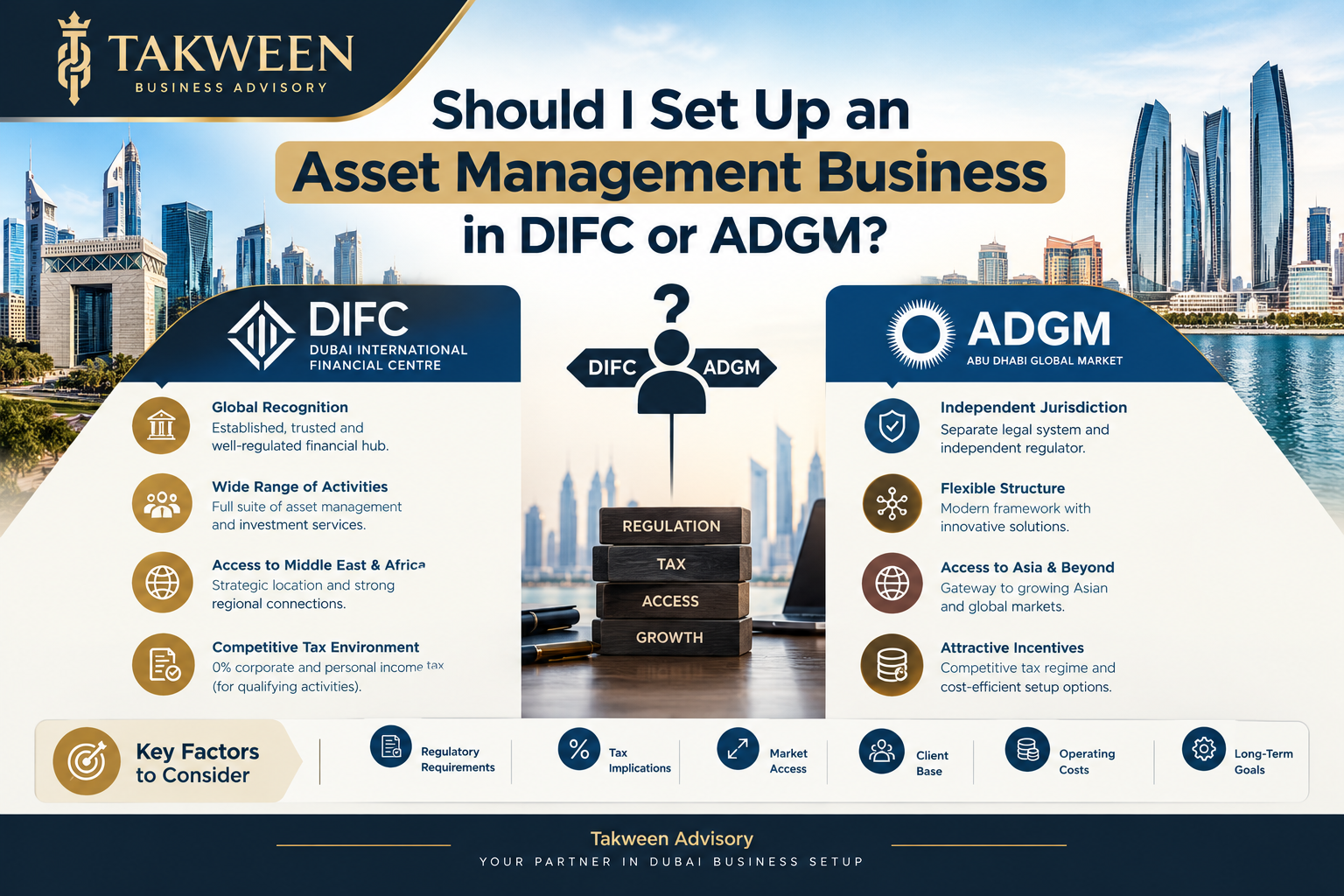
Choosing between the Dubai International Financial Centre (DIFC) and Abu Dhabi Global Market (ADGM) is one of the most consequential decisions a fund manager or wealth firm will make in the UAE. Both are common-law financial free zones with their own courts, their own regulators, and their own fund regimes - and both are genuinely credible homes for asset management Dubai businesses and their Abu Dhabi counterparts. But they aren't interchangeable. The right choice depends on your investor base, your capital structure, your appetite for digital assets, and how much weight you place on brand recognition versus cost efficiency. This guide breaks down the real differences so you can make an informed decision rather than a default one.
The Basic Setup: Two Regulators, One Legal Tradition
Both centres operate under English common law, independent of the UAE's civil law system, which makes them attractive to international investors and fund structures used to common-law contract enforcement. The key structural difference lies in who regulates you.
In DIFC, financial services fall under the Dubai Financial Services Authority (DFSA) - a regulator with a stricter, more established supervisory style often compared to the UK's FCA. In ADGM, the equivalent regulator is the Financial Services Regulatory Authority (FSRA), generally regarded as more flexible and faster in its processes. Both use the same core licensing category for fund and asset managers - Category 3C - covering the management of collective investment funds and discretionary asset management.
Cost: ADGM Generally Wins, But the Gap Narrows at Scale
If cost efficiency is your top priority, ADGM tends to come out ahead. Regulatory fees for FSRA-regulated activities generally run lower than DFSA's equivalent fee bands, and ADGM's registration costs for non-financial or holding structures are also typically lower than DIFC's. For a basic holding vehicle with no active operating business, ADGM is usually the cheaper route, partly because it doesn't require an audit below a certain revenue threshold and doesn't mandate a physical office for many structures.
For a fully regulated Category 3C fund or asset manager, the cost gap narrows considerably. Both centres carry meaningful application and annual regulatory fees, and DIFC's slightly higher costs are often offset by its larger surrounding financial ecosystem, deeper liquidity, and broader network of institutional counterparties. In short: ADGM tends to be cheaper for lean, single-activity setups, while DIFC's premium becomes easier to justify once you're running a full-scale, multi-activity operation with institutional ambitions.
Capital Requirements for Fund Managers
Base capital requirements differ modestly between the two. An Exempt or Qualified Investor Fund manager in DIFC typically needs base capital starting around USD 70,000, while the equivalent requirement in ADGM starts lower, generally around USD 50,000. Expenditure-based capital calculations also differ slightly in methodology, though both broadly tie required capital to a fraction of the firm's annual operating expenses.
DIFC also applies caps on investor numbers and certain thresholds for its Exempt Fund category, while ADGM's equivalent regime tends to offer more flexibility on those limits - a meaningful consideration if your target investor base is likely to grow beyond a narrow qualified-investor group.
Which Centre Fits Which Type of Asset Manager
This is really the heart of the decision, and it comes down to your business model more than your budget.
DIFC tends to be the stronger choice for:
-
Traditional, globally distributed asset management strategies
-
Hedge funds targeting private high-net-worth clients, supported by DIFC's deep private wealth networks and long-established investor community
-
Firms prioritizing an established financial centre brand - DIFC has operated since 2004 and carries significant international recognition
-
Businesses wanting proximity to Dubai's broader financial and real estate capital markets, including access to sovereign wealth pools like GIC and regional SWFs
-
Islamic finance and sukuk-related asset management, an area where DIFC has built particular depth
-
Firms that value DIFC's FinTech Hive ecosystem for related innovation, even if their core historical strength remains institutional banking and wealth management
ADGM tends to be the stronger choice for:
-
Private equity and venture capital structures, particularly those seeking proximity to Abu Dhabi's sovereign wealth institutions such as ADIA, Mubadala, and ADQ
-
Crypto and virtual-asset fund managers - ADGM's FSRA has regulated digital assets since 2018, making it one of the first jurisdictions globally to license exchanges, custodians, and token issuers, and it now holds a notable position in the region's virtual-asset landscape
-
Family offices and foundation structures, where ADGM's more recently updated regulations offer somewhat greater flexibility than DIFC's earlier framework
-
Firms prioritizing lean holding structures or SPVs, where ADGM's Special Purpose Vehicle and foundation regimes are considered among the most flexible in the region
-
Fund managers who value faster regulatory turnaround - ADGM's review process for licensing is generally quicker than DIFC's
Setup and Licensing Timelines
Timelines differ meaningfully between the two. DIFC is often noted for faster company registration in general, with visa processing typically completed within about a week. However, for a full regulated fund management license, ADGM's overall review process tends to move faster than DIFC's, with total licensing cycles for ADGM running roughly two to four months, compared to four to six months for a comparable DIFC license. If speed-to-market for a regulated fund manager matters more to you than day-to-day company administration speed, this distinction is worth factoring in carefully.
Digital Assets: A Clear Point of Differentiation
If your strategy involves crypto funds, tokenized assets, or virtual-asset management in any form, ADGM has a clear structural advantage. Its virtual asset framework has been in place since 2018 - making it one of the first regulated crypto regimes in the region - and it continues to expand its digital-asset licensing activity. DIFC has since introduced its own crypto token regime through the DFSA, but its regulatory culture remains more rooted in traditional institutional banking and wealth management, meaning firms centered on emerging asset classes will generally find ADGM's environment more tailored to their needs.
Physical Presence and Office Requirements
Both jurisdictions require some form of physical presence, though the minimum footprint varies by activity. Certain regulated categories in both centres permit a desk-based arrangement, while others require dedicated office space. Office costs in DIFC, located in the heart of Dubai's Gate District, tend to run higher than equivalent space in ADGM's Al Maryah Island campus in Abu Dhabi - another factor that tilts the overall cost comparison in ADGM's favor for firms watching their operating budget closely.
So, Which Should You Choose?
There's no universal answer, and any firm serious about asset management Dubai or Abu Dhabi operations should treat this as a strategic fit question rather than a pure cost comparison. If you're building a traditional fund targeting private wealth clients, want the credibility of a long-established financial centre, or plan to operate closely alongside Dubai's broader real estate and institutional capital markets, DIFC is the more natural home. If your priority is English-law flexibility for private market structures, proximity to Abu Dhabi's sovereign wealth institutions, a digital-asset-forward regulatory environment, or simply a leaner, faster, and more cost-efficient path to licensing, ADGM will often be the better fit.
Because the fee structures, capital requirements, and licensing timelines both shift periodically, it's worth getting current, activity-specific guidance before committing to either jurisdiction. Takween Advisory works with asset managers and fund structures across both centres and can help map your specific strategy, investor base, and capital plan against DIFC's and ADGM's current frameworks - so the decision is based on what actually fits your business, not just which centre has the more recognizable name.
Final Thoughts
DIFC and ADGM both offer 100% foreign ownership, English common-law governance, and credible Category 3C licensing pathways for asset managers - but they serve different strategic profiles. DIFC leans toward scale, established liquidity, and traditional wealth management; ADGM leans toward flexibility, cost efficiency, and emerging asset classes like digital assets and private equity. The right choice for your asset management Dubai ambitions ultimately comes down to matching your fund strategy and investor base to the regulatory environment built for it.









)


